
(This post is part of a series where we are discussing the experiences of undocumented folks and their families navigating this difficult period in order to raise awareness and increase support for those affected. If you have resources to share, please comment below. If you work at a school or organization, and are interested in hosting a talk, see the range of presentations we provide here.)
In recent days, there has been a significant increase in enforcement activities across the country. In California, concerning news of raids in or near churches, car washes, Home Depot, and farms have surfaced. As a result, families are contending with acute levels of fear and stress. This can prevent families from safely seeking resources and support when in need, including medical services. It can also disrupt their daily routines, commutes, and ability to rest. There are some parents, for example, who may be afraid of dropping off or picking up their children at school, especially if there are rumors about immigration raids in the neighborhood. Children may become particularly worried when their parents leave for work, feeling concerned about their safety during both the commute and the workday. Young adults, in particular, may volunteer to drive their parents, work longer hours, or take on responsibilities such as grocery shopping to reduce their parents’ exposure to risks outside the home.
Families are also being separated when a loved one is arrested, detained, or deported, causing financial strain, emotional distress, and significant disruptions to daily life. It is important to note that immigration agents often target fathers, leaving their spouses and eldest children to take on extra work or additional jobs to compensate for the lost household income. In the aftermath of an immigration arrest or deportation, family members also often experience anxiety, depression, and other emotional challenges. These struggles may manifest as sudden emotional breakdowns, irritability, or nightmares related to immigration.
There are also troubling reports of individuals being held in inhumane conditions, deported shortly after arrest, or transferred between multiple detention centers, making it difficult for their families to locate them.
Below, please find additional recommended readings to better understand what is currently happening in terms of U.S. immigration policy and enforcement, and its consequences. Also, stay tuned for a post next week where we will discuss ways allies can support families directly affected by an immigration arrest or deportation.
RECOMMENDED STUDIES ON IMMIGRATION ENFORCEMENT & ITS CONSEQUENCES
Banished Men: How Migrants Endure the Violence of Deportation (UC Press)
“What becomes of men the U.S. locks up and kicks out? From 2009 to 2020, the U.S. deported more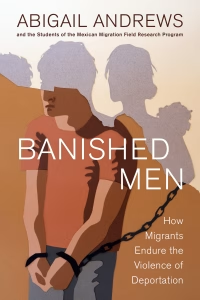 than five million people—over 90 percent of them men. In Banished Men, Abigail Andrews and her students tell 186 of their stories. How, they ask, does expulsion shape men’s lives and sense of themselves? The book uncovers a harrowing carceral system that weaves together policing, prison, detention, removal, and border militarization to undermine migrants as men. Guards and gangs beat them down, till they feel like cockroaches, pigs, or dogs. Many lose ties with family. They do not go “home.” Instead, they end up in limbo: stripped of their very humanity. Against the odds, they fight for new ways to belong. At once devastating and humane, Banished Men offers a clear-eyed critique of the violence of deportation.”
“Expanding Geographies of Deportability: How Immigration Enforcement at the Local Level Affects Undocumented and Mixed-Status Families” (Law & Policy)
“This article examines the impact of policies and programs that have expanded immigration enforcement from the federal to the local level. Drawing from in-depth interviews with over sixty individuals who are members of undocumented or mixed-status families, [the author] discuss[es] how these initiatives have extended the geography of deportability from traditional sites that focus explicitly on immigration enforcement (e.g., the US–Mexico border) to more nontraditional sites in the public sphere (e.g., driving under the influence checkpoints or grocery stores). [The author] demonstrate[s] how this intensification of enforcement strains undocumented immigrants’ resources as well as their participation in school, work, and their communities.”
“Punishment Beyond the Deportee: The Collateral Consequences of Deportation” (American Behavioral Scientist)
“Deportations from the United States reached record highs in the aftermath of the Great Recession (2007-2009). At the peak of this wave of deportations, over 400,000 people were deported from the United States—as many in 1 year as in the entire decade of the 1980s. The majority of these deportees have U.S. citizen family members, nearly all of whom continue to live in the United States. Over 90% of these deportees are men, and nearly all are sent to Latin America, creating gendered and raced consequences for specific communities. This article draws from interviews with 27 people from California who experienced the deportation of a family member to provide insight into the effects of deportation on these families. This article builds on scholarship on the collateral consequences of incarceration to enhance our understanding of the collateral consequences of deportation. The findings reveal that family members face short, medium, and long-term consequences in the aftermath of a deportation and that many adolescents are forced to make an abrupt transition to adulthood when one or both of their parents is deported.”
“The Educational Consequences of Parental Immigration Detention” (Sociological Perspectives)
“Every year, Immigration and Customs Enforcement imprisons hundreds of thousands of noncitizens as they await adjudication on their deportation proceedings. Importantly, many detained individuals have lived in the interior of the country for many years and are parents of young, dependent, school-age children living in the United States. This analysis brings together and builds upon research on parental incarceration and international migration. We analyze 104 multigenerational interviews conducted in California with detained parents, their current or former nondetained spouses/partners, and the school-age children they share. [The] findings suggest that children’s academic trajectories are seriously disrupted by the trauma, stigma, and strain of parental imprisonment. Moreover, these vulnerabilities are enhanced in unique ways by children’s positionality as members of mixed-immigration-status families facing the possibility of deportation. [The] findings suggest that parental immigration detention can have intergenerational consequences for children’s mobility that disrupt traditional pathways of immigrant integration in mixed-immigration-status families.”
ADDITIONAL RELEVANT IMMIGRATION NEWS COVERAGE
“Father in final stages of becoming U.S. citizen detained by ICE for weeks. His family wants to know why.” (CBS News, June 11th 2025)
“A father living in Milford, Massachusetts, who’s in the final stages of obtaining a Green Card to make him a permanent resident of the United States, has been in ICE custody for several weeks. His family wants to know why.”
 “Valley father detained by ICE while driving to work sparks protest for release” (AZ Mirror, June 11th 2025)
“In the early hours of June 4, 48-year-old Joel Gutierrez was driving his coworker to a home they were renovating in Phoenix when their work van was stopped by U.S. Immigration Customs and Enforcement officers.”
“Video: Woman sees her father being detained by ICE in downtown LA” (NBC Los Angeles, June 10th 2025)
“Two Los Angeles women said they are living through their worst nightmare: their fathers being taken away by immigration agents.”
“Lynn family says ICE detained father during purported wellness check” (NBC Boston, June 10th 2025)
“A family in Lynn, Massachusetts, says federal agents detained their father Monday morning during a so-called family welfare visit.”
“Torrance 9-year-old and his father detained by ICE, facing deportation, reports say” (ABC 7 News, June 6, 2025)
“Several Torrance residents are demanding answers after a 9-year-old boy stopped showing up to school only to be found in federal immigration custody.”
DON’T FORGET TO SHARE THIS PAGE WITH YOUR FRIENDS!
Don’t miss out on the latest resources available for undocumented students, make sure to “like” our page on Facebook and subscribe (it’s free)!
Are you interested in hosting an immigration presentation or workshop at your school or organization? Learn more about the range of speaking engagements we offer here.
 At My Undocumented Life we provide up-to-date information and resources for undocumented immigrants and allies. We post scholarship opportunities that are open to undocumented students, strategies for navigating the educational system, information on how to apply for DACA/Advance Parole, news on DAPA, and much more. Most importantly, we want to provide a sense of community to our diverse group of readers. Learn more about our work here: “About Us“
Share this:

Categories: Everyday Life While Undocumented, Get involved
 How to Support Immigrant Families Amid Heightened Enforcement: 12 Practical Recommendations
Leave a Reply