(Review and Interview by Angie)
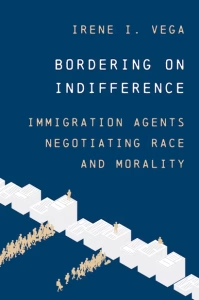 Dr. Irene Vega is an associate professor in the sociology department at the University of California, Irvine, whose work looks at immigration enforcement using a top-down approach, examining those who enforce immigration policies, such as immigration officers. She recently authored the book “Bordering on Indifference: How Immigration Agents Negotiate Race and Morality,” which focuses on the experiences of immigration agents, including how they navigate racial tensions and morality on the job. Dr. Vega interviewed 90 Border Patrol agents and ICE officers working along the U.S.-Mexico border.
We want to acknowledge that this is a particularly difficult moment for members of undocumented and mixed-status communities. As immigration enforcement escalates across the country—with officers raiding homes, workplaces, and sowing fear among families—Dr. Vega’s work feels especially urgent. Her book offers a tool for understanding how patterns of systemic indifference persist. In this post, we share a review of her book, followed by a Q & A with the author. For resources that can help families during the current political climate, we recommend these posts featuring information on Know Your Rights, rapid response networks, and list of steps others can take to support families.
Review of “Bordering Indifference”
In “Bordering on Indifference”, Dr. Vega does an excellent job in showing the reader how immigration agents, both Border Patrol agents and ICE officers, contend with the morality of their job using indifference. She also pays special attention to immigration agents’ negotiation of race, as over half of the agents she interviewed identified as Latino/a. Dr. Vega views immigration agents as street-level bureaucrats, a term coined by political scientist Michael Lipsky, referring to policy implementers who are granted immense power in legal and policy outcomes, due to their discretionary power. In the book, Dr. Vega does not focus on the experiences of agents in how they decide to arrest someone or not, but rather on how they grapple with the tension of being agents, specifically the moral economy of their job. Additionally, she focuses on the racialized tensions in how Latino/a and other agents reconcile with their duties of immigration enforcement. Her book is in chronological order, starting with their decision to go into the career path of immigration enforcement, the training process of becoming an agent, and the strategies they use while on the job.
In the first empirical chapter, Dr. Vega describes the four pathways in which agents apply to the profession: aspiring to be law enforcement, drifting into the job, the military-to-policing pipeline, and serving their country. For Latina/o agents, they primarily drifted into the job to secure a stable income with low educational qualifications. Agents who fell in the category of aspiring to be law enforcement or were fresh out of the military varied in their racial backgrounds. However, White agents mainly pursued the job because they wanted to serve the country, with some feeling a call to serve and secure the border after September 11, 2001. After guiding readers on how agents first apply to the job, Dr. Vega discusses how agents are trained and introduces the concept of manufactured ambiguity, which refers to agents’ perception that they never truly know who immigrants are or their intentions until they are processed and fingerprinted. Manufactured ambiguity is especially useful for Latino/a agents as they employ it to reconcile negative emotions when detaining and deporting immigrants.
Throughout the book, we are given a detailed explanation of how agents tackle the nature of their work. For instance, Dr. Vega writes about Latino/a agents engaging in caring control and disinterested professionalism when interacting with immigrants. Caring control is when agents try to improve the experience of immigrants when they are being detained or deported by speaking to them in Spanish, giving extra food or water, and even making jokes. Latina/o agents used caring control as a strategy when being called out for “policing their own” to make themselves feel better when interacting with Latino/a immigrants. Below is a small excerpt from the book showing caring control:
When immigrants reproached him for being a Mexican policing his own, he took the opportunity to remind them of the alternative. “One time an alien said, he goes, “Oh, are you Mexican?” And I go, “Well, my parents are.” He goes, “Are you a traitor?”And I go, “Well do you prefer that I arrest you and give you some food, give you water, or that a White guy arrests you and fucks you up?” And he goes no, “No, I prefer you officer.” (Vega, pg. 78).
Disinterested professionalism occurred when agents approached their work by treating everyone equally, regardless of ethnicity, gender, or age. This tactic allows agents to remain seemingly neutral on the job. Notably, Dr. Vega finds that it was more common for Latino/a agents to describe disinterested professionalism during situations where they noticed Latino/a migrants feeling more comfortable asking for things from them in comparison to White agents. We see this through the agent’s experience below:
He explained, ‘If you let them joke around, then that’s kind of a bad way of setting the tone. Because when you want them to do something, they might say, ‘Well, is this guy joking with me or is this guy being serious?’ Agent Juarez felt that his safety was contingent on him staying in control of the situation, and of migrants, so he stayed neutral, professional, and serious (Vega, pg. 89).
Dr. Vega notes that caring control and disinterested professionalism serve the same function of controlling immigrants, and in the end, ultimately benefit the state.
Returning to grappling with morality on the job, Dr. Vega finds that agents often deny responsibility for the violence they enact on immigrants and their families. She shares three forms of denial, namely, that of relying on the power and morality of the law, reframing their harm on immigrants by helping them, and blaming them for their choices. Denial through power and morality of the law is seen when agents limit their responsibility by viewing what is morally right in the law, simplifying family separation by following orders. Take the example below from the book showing how agents deny responsibility by relying on the law:
Officer Lardin told me, “Maybe for a few days, I felt bad,” but like colleagues, she did not see a role for herself in the family’s misfortune. Her sympathy had a certain distance and was tinged with apathy about her role in the whole matter. She was simply following directions from someone else, trying to find the people who were on a list that she had been handed. She explained, “It’s just kind of like one of those things like what can you do? They are on our list, and you have to go get them.” (Vega, pg.104).
To deny the harm of immigration control and recast it as help, agents would downplay its impact on immigrants. Agents would minimize the consequences by discussing how immigrants will eventually come back, or once they are deported, they are off the radar, making it easier to reenter the country. The prior two forms of denial were more common in Latina/o agents, while for White agents, they were more likely to blame immigrants for their own suffering. In general, these denial strategies allow agents not only to cope with their job but to continue doing it while staying indifferent to the harm and suffering they create.
Overall, the book contributes to the conversation of morality, street-level bureaucrats, immigration, and those with discretionary power. Dr. Vega ends by providing suggestions on how to move forward, one being disentangling the immigration system from the criminal legal system. She also provides readers with information on how she gained access to a hard-to-reach population in the appendix, which students, professors, and researchers would find particularly helpful. The book may also appeal to students taking a qualitative class on methods or organizers in rapid response networks. During this time of heightened immigration enforcement, I found the book eye-opening and informative in understanding how agents grapple with family separation and racial tensions.
Interview with the Author
- What motivated you to pursue this research and write the book?
My experience growing up in a border town has long been the backdrop to my interest in immigration enforcement. In addition to wanting to study the implementation politics of immigration law, I also wanted to understand the paradoxical combinations of social control and mobility that the immigration state creates in border towns like the one I grew up in. When I started this project, I knew that immigration enforcement agencies, like the United States Border Patrol, can be a coveted source of employment in the predominantly Mexican towns that dot the Southwest region of the U.S. I also knew that immigration control is racialized and has disproportionate impacts on these very communities. I wanted to square these two realities and get the perspectives of frontline agents who were doing this work.
- What did you do for this research project?
I interviewed ninety immigration enforcement agents—both U.S. Border Patrol Agents and Immigration and Customs Enforcement (ICE) Officers. I spoke to a diverse set of agents, but most of them were Latinas/os, children or grandchildren of Mexican immigrants, many of whom grew up along the U.S.-Mexico border they now policed. Bordering on Indifference tells the story of how these agents come into the work, how they are trained and socialized once on the job, and how that training and socialization impacts the way they reconcile its many moral and racial tensions. I draw contrasts and highlight similarities between Latina/o agents and their non-Latina/o peers, but the former are my main interlocutors because these agents wield the state’s coercive power but are also members of the racial/ethnic group that is disproportionately targeted by that power.
- What is something surprising you found out when talking to immigration agents?
If pressed to identify something “surprising” about doing this work, I would say that it was how simple it was to get access to these famously indisposed bureaucrats. By simple, I don’t mean easy—immigration agents are a hard-to-reach population, and I experienced my fair share of gatekeeping. But what worked in the end was simple, so straightforward that it had not occurred to me until I had exhausted myself trying other things. The book contains a methodological appendix where I elaborate the process of getting access to immigration agents and discuss some of the power dynamics inherent to studying organizational elites.
- Given what is occurring right now with immigration raids, masking agents, and the growing anti-immigration sentiment more generally, what is a key takeaway you hope readers will walk away with?
I want to be clear that the Border Patrol and ICE are not somehow experts at collecting unethical people that are eager to abuse, exclude, and discriminate. In fact, the federal government need not select people with ill intentions to produce ill outcomes. What the federal government needs to do, and what it does, is recruit people and train them to believe that they are on the right side of a series of debates about law, race, and morality that come with the job. Bordering on Indifference shows how that process happens, centering the experiences of Latina/o agents for whom those normative issues are least avoidable.
- What is next for you?
I am collecting data on the experiences of upwardly mobile adults in Southern California, with the aim of contributing to broader understanding of social stratification and opportunity structures in the region. I am also working on a new project on dissent in immigration bureaucracies.
Some parts of this Q&A are excerpted from Vega, Irene I. 2025. Bordering on Indifference: Immigration Agents Negotiating Race and Morality. Princeton University Press and a more detailed account can be found here.
Dr. Irene Vega’s main areas of expertise are international immigration, race/ethnicity, socio-legal studies, and educational inequality. She has published articles in Social Problems, Journal of Ethnic and Migration Studies, and other top journals. She has taught classes on qualitative methods and crimmigration.
Order Bordering on Indifference: Immigration Agents Negotiating Race and Morality and get 30% off with discount code: P327
ANGIE is a sociologist with research interests in immigration, deportation, health, and surveillance. Her work explores the reintegration experiences of undocumented immigrants with a deportation history living in the U.S. and the health consequences of border crossings and immigration enforcement.
DON’T FORGET TO SHARE THIS PAGE WITH YOUR FRIENDS!
Don’t miss out on the latest resources available for undocumented students, make sure to “like” our page on Facebook and subscribe (it’s free)!
Are you interested in hosting an immigration presentation or workshop at your school or organization? Learn more about the range of speaking engagements we offer here.
 At My Undocumented Life we provide up-to-date information and resources for undocumented immigrants and allies. We post scholarship opportunities that are open to undocumented students, strategies for navigating the educational system, information on how to apply for DACA/Advance Parole, news on DAPA, and much more. Most importantly, we want to provide a sense of community to our diverse group of readers. Learn more about our work here: “About Us“
Share this:

Categories: Book Reviews
Related Articles
-
 A Review of “Illegalized: Undocumented Youth Movements in the United States” and Q & A with author Dr. Rafael A. Martínez
-
 Understanding the Lives of Unaccompanied & Undocumented Young Adults: A Review of “Sin Padres, Ni Papeles” and Q & A with author Dr. Stephanie L. Canizales
-
 Book Review: Diary of a Reluctant Dreamer, Undocumented Vignettes from a Pre-American Life by Alberto Ledesma
-
 Book review: “Youth Held at the Border” by Lisa Patel
Leave a Reply